1. Company Situation
A hypothetical B2B SaaS company had developed a software platform designed to solve a specific operational challenge for mid-sized and enterprise businesses. The product had strong capabilities, but the company's marketing activity had become increasingly fragmented as the business expanded.
The marketing team was producing content, investing in SEO, participating in industry conversations, and running outreach campaigns. However, these activities were largely managed as separate initiatives.
As a result, the company generated awareness but struggled to build a predictable and consistent SaaS lead generation process.
Leadership wanted a marketing system that could connect brand positioning, organic discovery, demand generation, and conversion instead of treating each channel independently.
2. Core Marketing Challenges
The hypothetical company was experiencing several interconnected challenges:
- Weak or inconsistent market positioning
- Limited visibility for commercially relevant search terms
- Content that was not consistently aligned with buyer intent
- Inconsistent publishing and distribution
- Leads that varied significantly in quality
- Limited connection between marketing campaigns and sales objectives
- Weak conversion paths between content and high-intent pages
- PR and outreach activity operating separately from SEO and content
- Difficulty understanding which activities influenced qualified opportunities
The problem was therefore not necessarily a lack of marketing activity. It was a lack of integration.
3. Strategic Diagnosis
A SaaS marketing agency such as LeadCraft could begin by evaluating the complete customer journey rather than reviewing each marketing channel in isolation.
The diagnosis could examine:
The first priority would be clarifying the company's value proposition and target buyer segments. This would establish a foundation for the SaaS marketing strategy, ensuring that website messaging, content, SEO, outreach, and campaigns communicate a consistent business value.
The next step would be mapping existing content and marketing activity against customer intent to identify gaps, duplication, and missed opportunities.
4. Integrated Marketing Approach
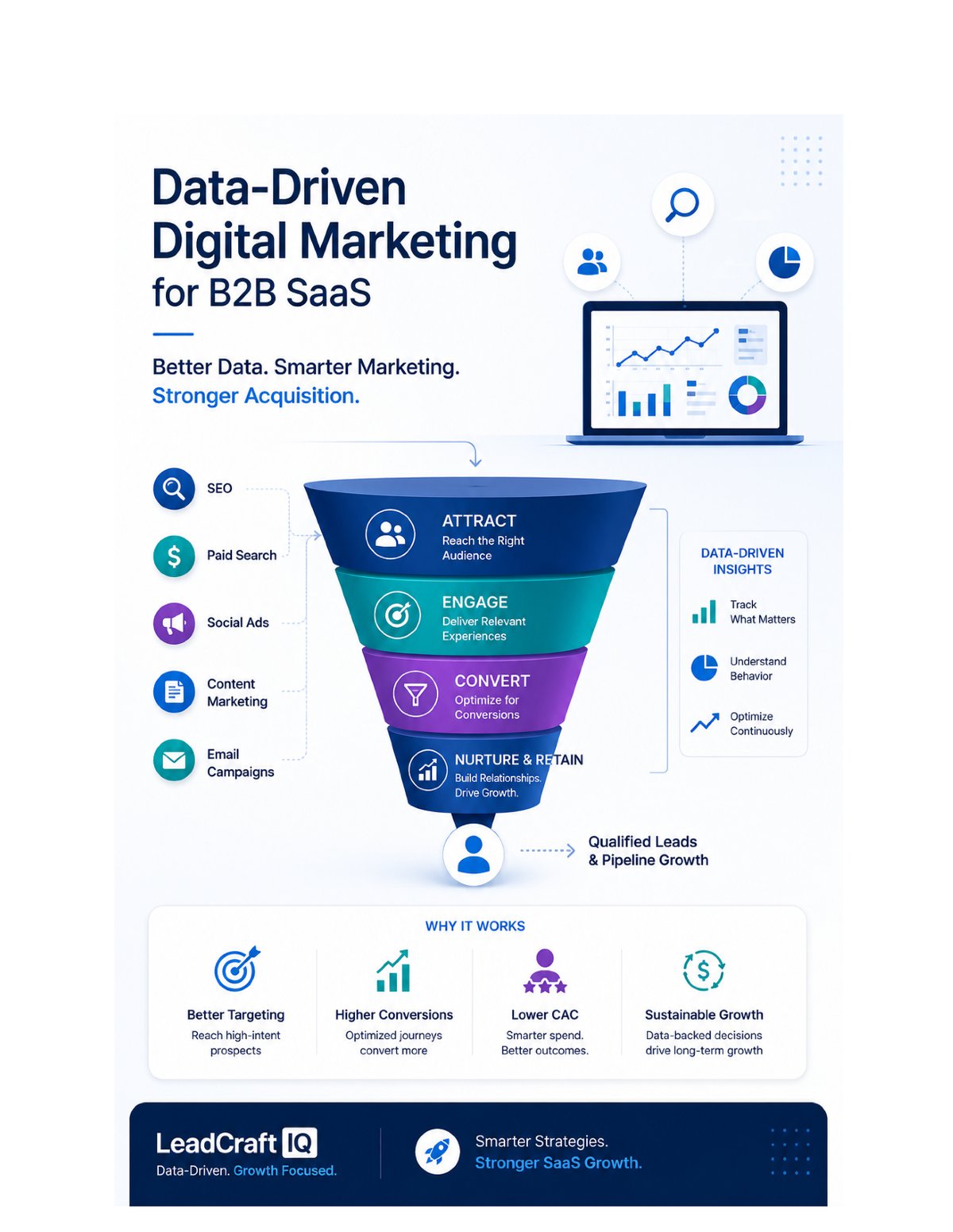
LeadCraft could develop an integrated B2B SaaS marketing framework around several connected pillars:
Brand Positioning
Clarify the company's target audience, core problem, differentiation, value proposition, and messaging priorities.
Content Marketing
Create educational, commercial, and decision-stage content aligned with customer questions and search intent.
SEO
Build visibility around strategically relevant keywords rather than focusing only on high-volume informational searches.
PR and Outreach
Use expert commentary, thought leadership, digital PR, and targeted outreach to strengthen authority and reach relevant audiences.
Demand Generation
Develop campaigns designed to create awareness and engagement among potential buyers who may not yet be actively searching for the product.
Conversion Optimization
Connect content and campaigns to relevant landing pages, product pages, lead magnets, demo opportunities, and other appropriate conversion points.
Together, these components could create a more connected SaaS growth marketing system.
5. Content and SEO Strategy
LeadCraft could create a structured content strategy based on keyword research and search intent.
Content could be organized into topic clusters covering:
- Industry challenges
- Problem-focused searches
- Solution-related topics
- Product use cases
- Comparison searches
- Implementation questions
- Buyer evaluation criteria
For example, an educational article could introduce a problem, link to a detailed use-case page, and guide qualified visitors toward a product or solution page.
Content marketing for SaaS would therefore become more than publishing regular blogs. Every content asset would have a defined role within the customer journey.
SEO would support this framework through keyword mapping, internal linking, technical optimization, topical authority, and conversion-focused content.
6. Demand Generation and Outreach
Organic search would be complemented by proactive demand generation. LeadCraft could identify relevant audiences and develop campaigns around their business challenges, industry trends, and emerging needs.
Potential activities could include:
- Thought leadership
- Executive content
- Industry insights
- Digital PR
- Strategic media outreach
- LinkedIn content
- Account-focused campaigns
- Email outreach
- Content distribution
- Industry partnerships
Rather than sending generic promotional messages, outreach could be built around useful insights and relevant business problems. This would help connect digital marketing for SaaS with broader authority-building and demand-generation objectives.
7. Conversion Optimization
Generating traffic and awareness is only part of the growth process. The hypothetical SaaS company could improve its conversion journey by reviewing how users move from initial content discovery toward meaningful business actions.
Potential improvements could include:
- Clearer content CTAs
- Relevant internal links
- Use-case landing pages
- Industry-specific pages
- Comparison pages
- Lead magnets
- Product demonstrations
- Consultation or sales inquiry pathways
- Stronger value propositions
- Reduced friction in conversion forms
Different visitors may require different conversion opportunities. Someone reading an introductory educational article may prefer a guide or checklist, while a high-intent visitor may be ready to explore a product page or request a conversation.
8. Measurement Framework & Expected Value
LeadCraft could establish a measurement framework that evaluates the entire marketing funnel:
- Visibility: Organic keyword visibility, search rankings, relevant organic traffic, brand mentions, media visibility.
- Engagement: Content engagement, returning visitors, landing-page engagement, content downloads, campaign interactions.
- Lead Generation: Qualified inquiries, marketing-qualified leads, sales-qualified leads, lead-source distribution, content-assisted conversions.
- Business Alignment: Lead quality, sales acceptance, pipeline influence, campaign contribution, cost efficiency where paid campaigns are involved.
No specific traffic, lead, revenue, conversion, or ROI figures are assumed in this hypothetical case study.
An integrated approach could potentially help the SaaS company establish a more consistent and scalable marketing system. Expected business benefits could include clearer market positioning, stronger organic visibility, better alignment between content and buyer intent, improved lead quality, more connected marketing channels, and clearer conversion pathways.
10. Lessons for SaaS Companies
The biggest lesson is that consistency does not mean simply publishing more content or running more campaigns.
When these components support one another, SaaS businesses can create a more structured approach to reaching potential buyers, demonstrating value, and generating qualified demand.
If your SaaS company is dealing with fragmented marketing channels, inconsistent leads, weak organic visibility, or content that is not converting enough business interest, talk to LeadCraft about your SaaS marketing strategy and growth objectives, and build a more connected approach to generating qualified B2B demand.