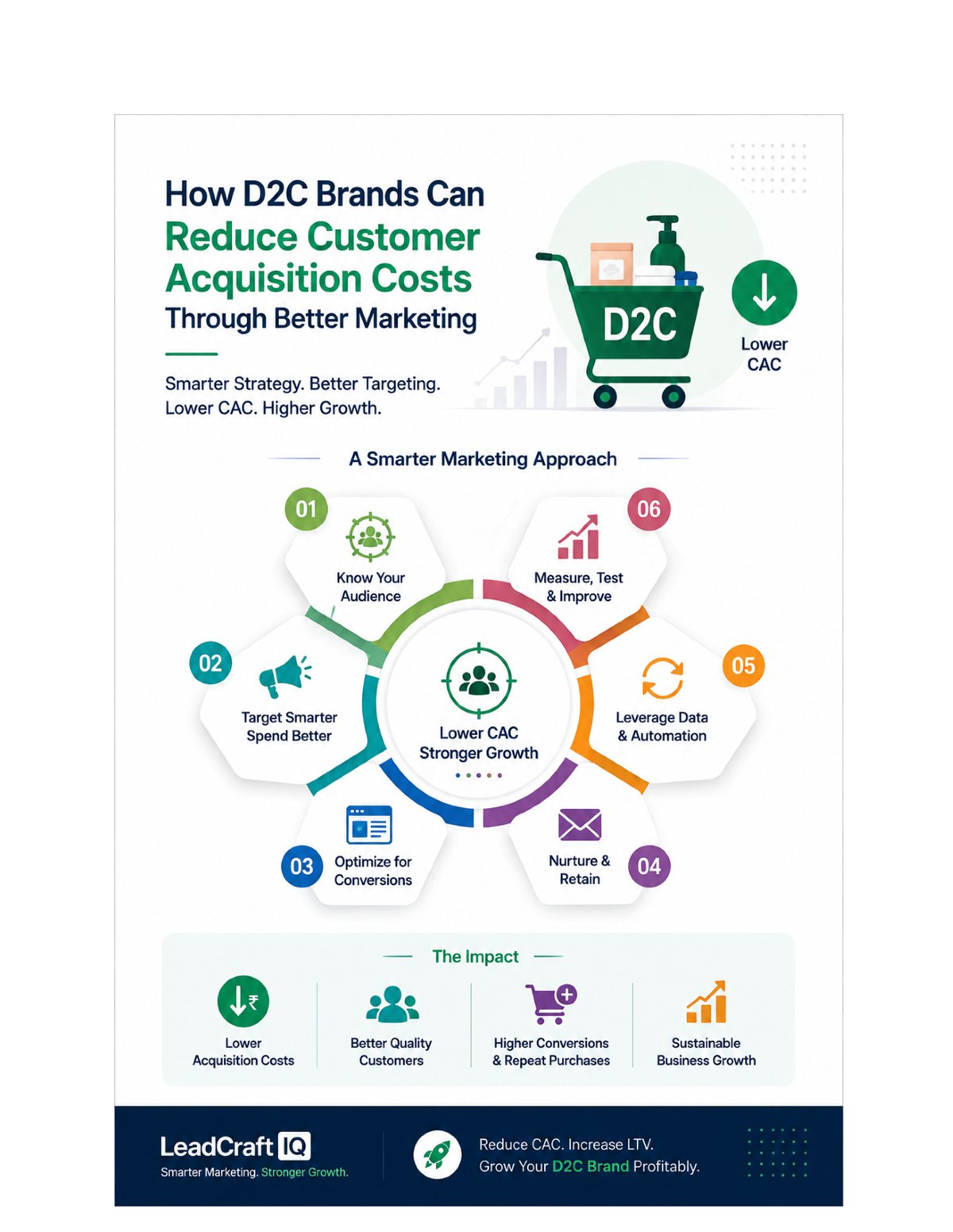
1. Overview: The Paid Scaling Trap
For D2C brands, increasing advertising spend does not automatically produce profitable growth. Rising customer acquisition costs, inconsistent ROAS, weak conversion tracking, and inefficient campaign structures can quickly turn a promising paid acquisition channel into an expensive growth constraint.
A hypothetical D2C wellness brand, Company A, was experiencing these challenges. Its Google Ads account generated sales, but the business lacked the visibility and campaign structure needed to scale profitably.
2. Business Challenge
Company A sold premium wellness products through its ecommerce website. The brand was investing approximately $45,000 per month in paid advertising, but performance varied significantly across campaigns and products.
Key challenges included:
- Rising customer acquisition costs: Increasing cost-per-click and bidding inefficiencies drove CAC above target thresholds.
- Inconsistent ROAS: High return on some legacy search terms was masked by heavy losses across automated campaigns.
- Poor conversion tracking: Lack of server-side or enhanced conversion tracking created attribution blind spots.
- Underperforming product feeds: Merchant Center feeds lacked optimized titles, product types, and custom labels.
- Wasted ad spend: Broad automated matching pulled in low-intent, non-converting search queries.
- Irrelevant search queries: Poor negative keyword hygiene drained budget on irrelevant queries.
- Weak landing-page experiences: Traffic landed on generic collection pages rather than high-converting product landers.
- Inefficient campaign structures: High-margin flagship items competed against low-margin inventory in single campaign pools.
- Difficulty scaling profitable products: Budget caps on winning campaigns prevented profitable revenue expansion.
The marketing team was primarily evaluating advertising performance through revenue and ROAS. However, product margins and customer acquisition economics were not consistently incorporated into budget decisions. The company needed a more structured D2C customer acquisition approach that connected ad spend with revenue, margins, CAC, conversion rate, and customer value.
3. Account Audit Approach
LeadCraftIQ conducted an account-level assessment of Google Ads for D2C, beginning with tracking infrastructure and campaign performance:
The review covered:
- Conversion tracking and multi-touch attribution accuracy
- Google Ads account structure and bidding strategies
- Product-feed quality, attributes, and custom labels
- Campaign and product segmentation by profitability tiers
- Search-term performance and query intent analysis
- Negative keyword opportunities and list automation
- First-party audience data and customer match segments
- Landing-page performance and PDP conversion rates
- Product profitability, gross margins, and return rates
- Budget allocation by campaign efficiency
- Customer acquisition economics (CAC to LTV ratios)
The objective was not simply to improve ecommerce ROAS on a dashboard. It was to identify where advertising investment generated sustainable business contribution and where budget was being wasted.
4. The Solution: Margin-Based Campaign Architecture
The resulting D2C Google Ads strategy reorganized campaigns around product performance, customer intent, and profitability:
1. Product Feed Overhaul & Custom Label Segmentation
Product feeds were enriched with high-intent search keywords, detailed attributes, and custom labels segmenting products into Best Sellers, High Margin, Break-even, and Liquidation tiers.
2. Performance Max & Shopping Restructuring
Shopping and Performance Max campaigns were restructured around meaningful product groups and business priorities, separating top performers from testing groups to prevent budget cannibalization.
3. Aggressive Negative Keyword Management
Search-term analysis was used to eliminate irrelevant queries and build a shared negative-keyword library across brand and non-brand campaigns.
4. Profit-Aligned Smart Bidding
Budget allocation was redirected toward campaigns demonstrating superior gross margin contribution. Bidding targets (tROAS and tCPA) were calibrated against actual unit economics rather than top-line revenue.
5. Dedicated Landing Page Alignment
The team improved landing-page alignment, strengthened product messaging, tested creative variations, and introduced remarketing opportunities for high-intent browse abandoners.
6. Reliable First-Party Measurement Foundation
Server-side tracking and Enhanced Conversions provided the clean measurement foundation needed for ongoing Google Ads management and algorithmic learning.
5. Expected Business Value
An illustrative before-and-after scenario highlights how restructuring campaign spend and improving conversion quality unlocks profitable scaling:
| Metric | Before | After |
|---|---|---|
| Monthly Ad Spend | $45,000 | $50,000 (+11.1%) |
| Attributed Revenue | $135,000 | $195,000 (+44.4%) |
| Blended ROAS | 3.0x | 3.9x (+30%) |
| Ecommerce Conversion Rate | 1.9% | 2.5% (+31.6%) |
| New Customers per Month | 820 | 1,150 (+40.2%) |
| Customer Acquisition Cost (CAC) | $54.88 | $43.48 (-20.8%) |
| Average Order Value (AOV) | $165 | $170 |
The higher ad spend was justified because incremental revenue and customer unit economics supported sustainable, profitable growth.
The example demonstrates why D2C PPC campaigns should be evaluated beyond surface ROAS. A profitable ecommerce PPC strategy considers revenue, gross margin, CAC, conversion rate, repeat-purchase potential, and customer lifetime value.
6. Conclusion & Next Steps
Effective Google Ads for D2C is not simply about spending more or chasing platform-reported conversions. It requires disciplined campaign management, accurate measurement, product-level analysis, strong landing pages, and a clear understanding of customer economics.
For growing ecommerce brands, the right D2C paid advertising strategy can eliminate wasted spend while building a predictable customer acquisition engine.
LeadCraftIQ's paid media services integrate full-funnel tracking, feed optimization, margin-based bidding, and conversion design to scale D2C ecommerce brands profitably.
Want to identify where your paid acquisition budget is being wasted? Request a free paid-growth audit from LeadCraftIQ and get a data-backed roadmap to improve campaign efficiency, reduce customer acquisition cost, and scale profitably—not just spend more.